Section A–A: what people use above the line, what runs beneath it below. Drag the linean A to move the cut.
I build the software people see, and everything it stands on.
By day, brain-MRI platforms and the research infrastructure under them, at NYU Abu Dhabi and Sentinel. Around that, an open-source DICOM library in pure Go, and three browser games that teach the Linux kernel, routing, and DICOM on the real thing.
Most engineers pick a layer. This sheet shows what happens when you don’t.
The first alpha is out and playable. Building on the story-driven Linux game: real Linux in the browser, an X-ray view of the kernel, and lessons from the shell toward kernel development.
Help wanted. Play-testers for the alpha, Linux and kernel folks to review lessons, and contributors to the open source.
1.9.1 is out: show reads implicit VR files with each value's real VR, reads text in the character set the file declares, and leaves bulk data in the file, 18 MB of memory for a 200 MB image where it took 218. 1.9.0 brought show --json, every element with its byte offsets, and -events, each PDU and message on an association. 1.8.0 brought de-identification from the command line, a client, images rendered to PNG, and a JPEG Baseline encoder.
Help wanted. Issues, pull requests, and real-world testing, especially from people who work with DICOM day to day.
The alpha is out and playable: a game that teaches on a real network. Twenty-six missions are written, from a first router through OSPF and IS-IS to recovering from a failure.
Help wanted. Network engineers to play the mission and say where it loses them, and contributors to write missions.
The third game, and its first alpha: learn from the first byte to the network, on real go-dicom running in Linux in your browser. Its fourteen missions, in stages 1 and 2, open a Part 10 file and read its elements; the association and query and retrieve come next.
Help wanted. People who work with DICOM every day, to play it and say where it is wrong, and contributors to write missions.
Shows which new files no human has opened yet. Built for working with coding agents: when they add dozens of files in minutes, you still know which ones nobody has looked at. Built on human-centred design: it informs and never blocks, opening a file is the only signal, and it stays local, with no telemetry and no network.
Help wanted. Developers who work with coding agents, to pilot it and say where it gets in the way.
Right-click a Markdown folder or file and read it in your browser, as GitHub-style pages with a tree of exactly what you picked, working links and anchors, and Back and Forward. It finds Markdown the way git does, and still opens an ignored folder you choose. Built on human-centred design, and safe by default: the server answers only this machine at a private address, serves only what you opened, and never runs a document's scripts.
Help wanted. Developers who read docs, plans and agent output in their repositories, to pilot it and say where it gets in the way.
Traces any tag or header field from its value to the exact bytes that encode it. The image, the tag tree and the bytes sit side by side and stay linked: select a tag and the bytes of its tag, VR, length and value light up; click a byte and its tag is selected. A range is shown only when it holds, and is otherwise named as unavailable with the reason. Built on human-centred design: useful when a file is broken, read-only, and nothing leaves your machine. It reads DICOM through go-dicom 1.9.1.
Help wanted. People who debug imaging files, to pilot it on the files that give them trouble and say where it points to the wrong bytes.
Sheet · LAMINATESentinelResearch, hospital pilots, and production use1 of 8
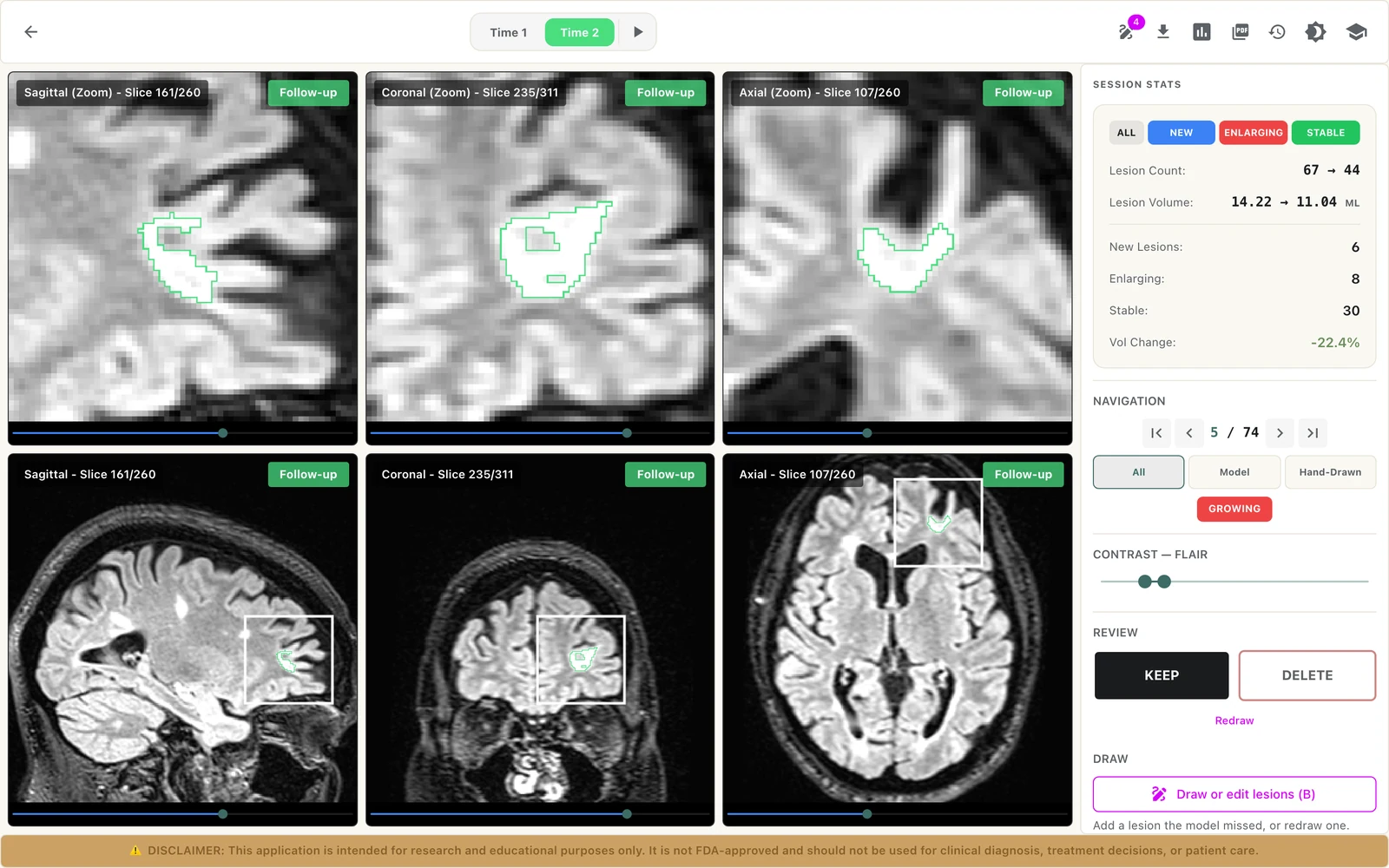
Fig. 2a. Longitudinal lesion review.
What changed in this brain since the last scan?
LAMINATE
Brain MRI analysis and longitudinal lesion assessment
Research and clinical teams need to process brain MRI, assess lesions, and compare scans across time points without stitching together separate tools.
Role. Develops LAMINATE end to end: frontend, backend, imaging integrations, and infrastructure.
Web and cross-platform desktop applications for medical image visualization
Longitudinal lesion review across time points
Dataset ingestion and analysis workflows with asynchronous processing
On-site gateways that connect hospital to processing services, with local de-identification and return of results
Used across research, hospital pilots, and production
Runner-up, Innovation Award, Abu Dhabi Global Health Week 2025 (team award)
React · TypeScript · · · FastAPI · Docker
Where does a scan go after it leaves the scanner?
XNAT infrastructure
The imaging archive, and the path from a scan to compute
Researchers need a dependable imaging archive connected to compute, so quality control and large-scale analysis don’t depend on manual data handling.
Role. Installs and administers XNAT, leads the migration from the previous system, operates the Docker Swarm cluster, and implemented the Slurm integration.
deployed on a local Docker Swarm cluster
Custom integration with a Slurm-based HPC cluster
Researcher-facing CLIs and analysis pipelines
Automated quality control
Large-scale analysis across large imaging datasets
· Docker Swarm ·
What is actually inside a medical image file?
go-dicom
Pure Go DICOM library and CLI, no CGO
Imaging platforms need a fast foundation without a C toolchain behind it. go-dicom began from that need while building CIQE, and is released as a public tool anyone can use.
Role. Created and maintains go-dicom as an independent open-source project.
Pure Go with no CGO
file I/O and pixel decoding
networking, including storage, query, and retrieval
A client for QIDO-RS, WADO-RS, and STOW-RS
De-identification under the PS3.15 profiles, burned-in text included
What if the archive, the pipeline, and the workspace were one place?
CIQE
Cognitive Informatics Quantification Engine
Imaging research spreads across archives, ingestion, data management, curation, and compute. CIQE aims to bring them into one platform.
Role. Technical Lead.
Intended scope: imaging archives, ingestion, research data management, dataset curation for machine learning, analysis workflows, compute orchestration, and research workspaces
A portal and demo with domain packages, imaging views, datasets, and workflow surfaces
Upcoming; frontend and demo surfaces in progress
What really happens when you type ls?
Kernelfall
A story-driven browser game that teaches Linux, from shell to kernel
The path from using Linux to writing systems C and kernel code is steep and hard to see. Kernelfall makes it hands-on and visible.
Role. Independent project: design and engineering.
Real Linux running in the browser through
An X-ray view that exposes kernel activity as the learner runs commands and writes programs
VM worker, kernel trace events, objective checks, and data-driven lesson content
First alpha released and playable in the browser
Prologue, shell fundamentals, and early Act I in development
Drivers, synchronization, memory, and deeper kernel topics on the roadmap
What happens to a scan between the scanner and the archive?
DICOMfall
A browser game that teaches DICOM, from the first byte to the network
is learned from a standard thousands of pages long, and few people can open a real archive to watch it work. DICOMfall puts one in the browser, with synthetic data.
Role. Independent project: design and engineering.
Real go-dicom running on Linux in the browser through
One synthetic CT instance followed from disk into an archive, one idea per mission
Inspect the evidence, predict, act, and check the result against go-dicom’s own reading
First alpha: stages 1 and 2, fourteen missions on a Part 10 file and its data elements
Six stages planned, through the association, query and retrieve, and interoperability
How does one codebase give every school the app it asked for?
NoorSpace & education apps
Mobile apps for parents, students, teachers, and staff
Every school brand comes with its own requirements: its branding, the features it needs, and how it works. Each still needs a dependable app on iOS and Android, without a separate codebase to maintain.
Role. Mobile engineer: shared architecture, features, integrations, reliability, and releases.
One shared codebase, with each school’s branding, features, and rules configured on top of it
Microsoft 365 sign-in
Counseling and follow-up, attendance, attachments, and notification navigation
API compatibility, testing, and iOS/Android releases, with over-the-air updates through Expo
Each school gets an app built to its requirements, delivered and maintained from one codebase
React Native · Expo · TypeScript
Bill of materials
Table 1. What each layer is made of, and where to see it.
LayerBuilt withSeen in
L0
Interfaces
Review screens, desktop and mobile apps, and editor extensions people work in.
Technical lead at Sentinel, the company behind LAMINATE and the upcoming CIQE platform.
Develops LAMINATE end to end
Leads engineering across LAMINATE and CIQE
C
2023–now
Software EngineerNYU Abu Dhabi · full time
Research software and medical imaging infrastructure: the XNAT imaging archive, HPC integration, and researcher-facing tools.
Installs, administers, and manages XNAT, including migration from the previous system
Runs the local Docker Swarm deployment
Built custom integration with the Slurm-based HPC cluster
Designs CLIs and analysis pipelines for researchers
D
2023–now
Mobile EngineerUltimit ATS · part time
Education mobile applications for school communities, including NoorSpace, delivered on iOS and Android.
Shared application architecture across multiple school brands
Features, integrations, reliability, and releases
B
2022–2023
Student InternNYU Abu Dhabi · internship
Joined NYUAD’s research software work before moving into a full-time role.
A
2017–2022
Network EngineerAman IT · contract
Built networks and data centers and kept distributed sites connected.
Municipal and distributed-site networking
Wireless links and VPNs
Installing and configuring communication links
Network monitoring
Open source patches
Table 3. Released tools and upstream fixes.
Created · Go · open source
go-dicom
Pure Go DICOM library and CLI, no CGO. File I/O, pixel decoding, and DIMSE networking for storage, query, and retrieval. Amr’s own project, open to anyone under the MIT licence.
An operational tracking and reporting application covering customers, drivers, materials, vehicles, documents, and reports.
Django · TypeScript
Aman Center application
A case-data archive and analytics application helping Aman Center — The Arab Center For Safe Society organize records and understand patterns through statistical reporting.
React · TypeScript · Django
Logistics & Order Management Platform
A logistics and business-operations application covering items, orders, suppliers, vehicles, and transport pricing.
React · TypeScript · Django REST
References
Research, recognition, training, and writing.
[1] Publication · co-authored abstract
Longitudinal AI-Based MS Lesion Segmentation Tool for Heterogeneous MRI Datasets
Multiple Sclerosis and Related Disorders, vol. 114, suppl. 1, 107459, October 2026. Contribution: platform software, internal tools, and pipeline integration.